
Solar for Housing Societies: Costs, Approvals and How Committees Fund It
Saraswati Solar Team · 8/5/2026 · 9 min
Lifts, pumps, corridor lighting and the STP run every day. Here is how an RWA turns that common-area bill into a three-to-four year payback.
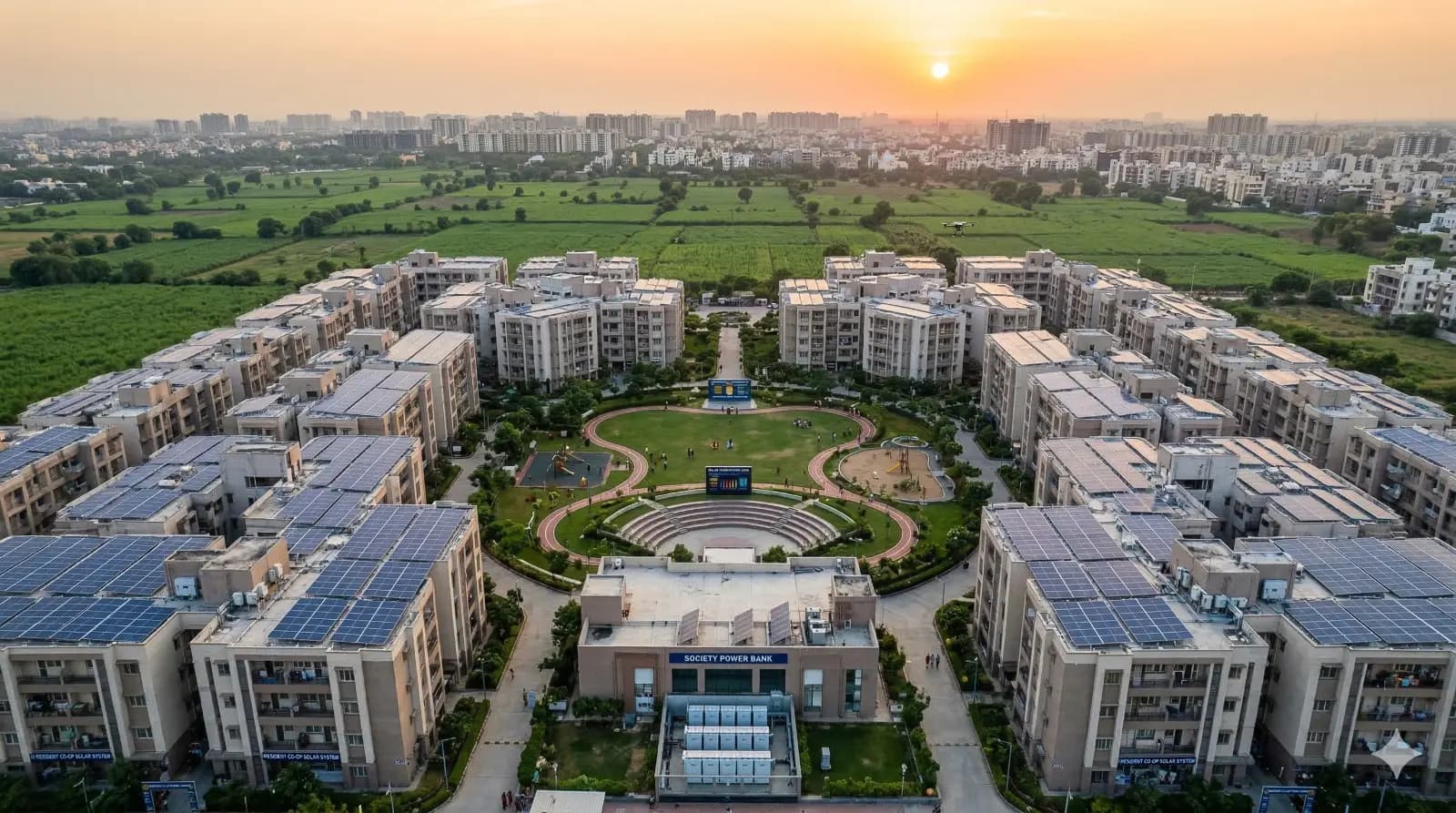
Common-area electricity is one of the largest recurring line items in a housing society budget. Lifts, water pumps, corridor lighting, the STP and the club house run every single day, and solar addresses that load directly.
What a society system usually covers
Most society projects target the common-area connection rather than individual flats, because one connection, one meter and one bill keep the approvals and the accounting straightforward. Individual owners can still go solar on their allotted terrace share separately where the bylaws permit it.
Costs at society scale
Society systems typically land between 20 kW and 100 kW, where the rate drops to about ₹42 per watt for 15 to 24 kW and around ₹40 per watt from 25 kW upward. A 50 kW system therefore sits near ₹20 lakh and offsets a substantial share of a common-area bill running into lakhs each year.
Approvals and paperwork
- A managing committee resolution, and in many societies a general body approval, authorising the project and the spend
- Terrace usage rights confirmed against the bylaws and the builder's handover documents
- Net metering application against the common-area connection, with sanctioned load and single-line diagram
- Structural fitness confirmation for the terrace, particularly on older buildings
How societies pay for it
Some fund it from the sinking fund, some from a one-time contribution per flat, and some through a loan serviced entirely out of the savings. Because the electricity saving is immediate and predictable, the loan route works well when the committee would rather not touch reserves.
What to check in a proposal
Ask for the structure design and wind-load calculation, walkway and cleaning access, cable routing that does not compromise waterproofing, lightning protection and earthing, monitoring access for the committee, and a written AMC scope. At this scale, workmanship on structure and cabling matters more than the module brand.
Living with the system
Give the committee a monitoring login so any member can check generation, and put quarterly cleaning and an annual electrical inspection into the AMC. A 50 kW system nobody cleans quietly loses more money each year than the AMC would have cost.
We have executed society projects across Mohali, Zirakpur, Panchkula and Chandigarh, and we are happy to present the numbers to your committee before you float a tender.